national leaders in ucl repair, tommy john surgery & THrowing Athlete Care
tommy john surgery, ucl repair & throwing Athlete Care
A torn ulnar collateral ligament can affect a baseball pitcher’s ability to throw, but UCL injuries also occur in softball players, quarterbacks, tennis players, javelin throwers and other overhead athletes.
At Andrews Sports Medicine, our fellowship-trained sports medicine surgeons specialize in diagnosing and treating UCL injuries of the elbow. Treatment options include non-surgical care, UCL repair with internal brace augmentation and UCL reconstruction—commonly known as Tommy John surgery.
Our goal is not simply to treat the injury. It is to help each athlete protect long-term elbow health and safely return to competition.
national leaders in tommy john surgery & ucl repair
Andrews Sports Medicine and the American Sports Medicine Institute have helped advance the evaluation, surgical treatment and rehabilitation of throwing-related elbow injuries for decades.
Our physicians, researchers, physical therapists and biomechanical experts work together to study how UCL injuries occur, improve treatment techniques and help athletes return to competition safely.
This integrated approach gives athletes access to specialized care informed by clinical experience, biomechanics research and published patient outcomes.
what is the ulnar collateral ligament?
The ulnar collateral ligament, commonly called the UCL, is a band of tissue located along the inside of the elbow. It helps stabilize the elbow during throwing and other overhead movements.
Repeated high-stress throwing can gradually weaken the ligament. A UCL injury may also occur suddenly during a single throw or athletic movement.
UCL injuries range from mild sprains and partial tears to complete ligament tears. The location of the tear, quality of the remaining tissue, athlete’s age and competitive goals all help determine the appropriate treatment.
symptoms of a ucl tear
Symptoms can develop gradually or begin with a sudden injury. Common signs of a UCL injury include:
- Pain along the inside of the elbow
- Pain during the acceleration phase of throwing
- Reduced throwing velocity or accuracy
- Loss of endurance or control
- A feeling of looseness or instability in the elbow
- A sudden pop during a throw
- Numbness or tingling in the ring and little fingers
Not every athlete experiences the same symptoms. An evaluation by a sports medicine physician can help distinguish a UCL injury from other causes of medial elbow pain.
how is a ucl tear diagnosed?
Diagnosis begins with a detailed history and physical examination. Your physician will discuss when the pain started, where it occurs and how it affects throwing or athletic performance.
The evaluation may include:
- Assessment of elbow stability, strength and range of motion
- Review of throwing workload and recent changes in activity
- X-rays to evaluate the bones and joint
- MRI or MR arthrogram to examine the ligament and surrounding tissue
- Evaluation of the shoulder, forearm and overall throwing motion
The diagnosis is based on the complete clinical picture—not imaging alone.
does every ucl tear require tommy john surgery?
No. Some UCL injuries can be treated without surgery, particularly when the elbow remains stable and the athlete’s symptoms, tear pattern and performance goals support a non-surgical approach.
Non-surgical treatment may include:
- Temporary rest from throwing
- Anti-inflammatory treatment when appropriate
- Physical therapy
- Shoulder, elbow, forearm and core strengthening
- Correction of throwing-mechanics or workload concerns
- A progressive return-to-throwing program
If symptoms continue despite appropriate treatment, or if the ligament cannot provide the stability required for competition, surgery may be considered.
ucl repair vs. tommy john surgery?
UCL repair and UCL reconstruction are different procedures. The most appropriate option depends on the location of the injury, tissue quality, chronicity of the tear and the athlete’s individual needs.
UCL Repair With Internal Brace
UCL repair may be appropriate for selected athletes with a repairable tear and healthy ligament tissue.
During the procedure, the surgeon repairs the athlete’s native ligament and reinforces it with a high-strength suture-tape internal brace. The internal brace acts as a protective scaffold while the repaired ligament heals.
Potential advantages for appropriately selected athletes include preserving the native ligament and following a rehabilitation progression that may be faster than traditional reconstruction. UCL repair is not appropriate for every tear.
UCL Reconstruction: Tommy John Surgery
UCL reconstruction replaces the damaged ligament with a tendon graft taken from the patient or, in selected cases, donor tissue. The procedure is commonly known as Tommy John surgery.
Reconstruction may be recommended for:
- Chronic or degenerative UCL tears
- Poor ligament tissue quality
- Tears involving the middle portion of the ligament
- Complete tears that cannot be repaired
- Failed previous treatment
- Certain revision cases
The surgeon secures the graft to the ulna and humerus to recreate the function of the injured ligament.
evidenced-based ucl repair backed by published outcomes research
In January 2025, the American Journal of Sports Medicine published “Clinical Outcomes of Ulnar Collateral Ligament Repair with Internal Brace versus Ulnar Collateral Ligament Reconstruction in Competitive Athletes.”
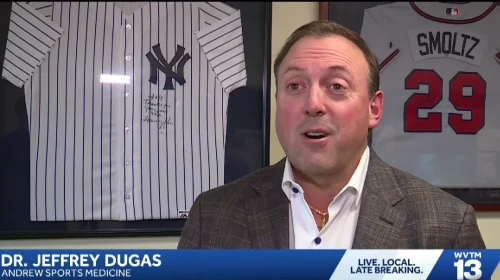
The study was conducted at the American Sports Medicine Institute in Birmingham and included Andrews Sports Medicine physicians Jeffrey R. Dugas, MD; Marcus A. Rothermich, MD; Benton A. Emblom, MD; and E. Lyle Cain Jr., MD.
The study was conducted at the American Sports Medicine Institute in Birmingham and included Andrews Sports Medicine physicians Jeffrey R. Dugas, MD; Marcus A. Rothermich, MD; Benton A. Emblom, MD; and E. Lyle Cain Jr., MD.
The research compared clinical outcomes, return to play and complications following UCL repair with internal brace augmentation and traditional UCL reconstruction in competitive athletes.
The findings support an individualized approach: selected athletes with repairable UCL tears may achieve strong outcomes with internal brace repair, while reconstruction remains an important treatment for chronic tears, poor tissue quality and other injuries that cannot be repaired.
This research is part of our continued commitment to advancing UCL treatment and improving care for throwing athletes.
[BUTTON: READ THE PUBLISHED UCL STUDY]
tommy john surgery recovery & return to throwing
Recovery after UCL surgery is a gradual, criteria-based process. Rehabilitation begins with protecting the healing ligament or graft while restoring elbow motion. Athletes then progress through strengthening, throwing and sport-specific phases.
A rehabilitation program may include:
- Protection of the elbow during early healing
- Progressive restoration of range of motion
- Shoulder, elbow, forearm and core strengthening
- Evaluation of throwing mechanics
- A structured interval-throwing program
- Gradual progression to pitching or full competition
Athletes who undergo UCL repair may be able to progress more quickly than athletes who undergo reconstruction, but recovery differs for every patient. Returning too quickly can place the healing ligament or graft at risk.
The decision to begin throwing and return to competition is based on healing, strength, range of motion, throwing tolerance, position and competitive level—not the calendar alone. Pitchers recovering from Tommy John reconstruction should generally expect the complete return-to-competition process to take a year or longer.
specialized care for throwing athletes
Treating a UCL injury requires more than repairing a ligament. Our team evaluates the entire throwing athlete, including shoulder mobility, elbow stability, strength, workload, mechanics and previous injury history.
Andrews Sports Medicine works closely with the American Sports Medicine Institute, a nationally recognized leader in sports medicine research and education. This relationship connects patient care with biomechanics research, rehabilitation expertise and decades of experience caring for throwing athletes at every level.
Our specialists care for youth, high school, collegiate, professional and recreational athletes with one goal: helping each patient pursue a safe, durable return to performance.
our ucl & throwing athlete specialists
Our fellowship-trained orthopaedic sports medicine physicians include nationally recognized leaders in UCL surgery, throwing-related elbow injuries and sports medicine research:
- E. Lyle Cain Jr., MD
- Jeffrey R. Dugas, MD
- E. Lyle Cain Jr., MD
- Benton A. Emblom, MD
- Christopher H. Garrett, MD
- B. Wayne McGough, Jr., MD
- Marcus A. Rothermich, MD
[BUTTON: MEET OUR SPORTS MEDICINE TEAM]
frequently asked questions about tommy john surgery
What is Tommy John surgery?
Tommy John surgery is another name for UCL reconstruction. During the procedure, a damaged ulnar collateral ligament in the elbow is replaced with a tendon graft to restore stability.
Is UCL repair the same as Tommy John surgery?
No. UCL repair preserves and repairs the athlete’s existing ligament, typically with internal brace augmentation. Tommy John surgery reconstructs the ligament using a tendon graft. The appropriate procedure depends on the tear pattern, tissue quality and athlete’s needs.
Can a torn UCL heal without surgery?
Some partial UCL tears and sprains can improve with rest, rehabilitation and a gradual return-to-throwing program. Complete tears or injuries that continue to cause instability and impaired performance may require surgery.
Who is a candidate for UCL repair with an internal brace?
UCL repair is generally considered for selected athletes with an acute tear in a repairable location and healthy remaining ligament tissue. A physical examination and imaging are necessary to determine whether repair or reconstruction is appropriate.
How long does recovery from Tommy John surgery take?
Recovery varies based on the procedure, athlete, position and progress during rehabilitation. Pitchers undergoing UCL reconstruction commonly require a year or longer before returning to full competition. Your physician and rehabilitation team will develop an individualized timeline.
When can I begin throwing after UCL surgery?
Throwing begins only after adequate healing, motion and strength have been restored. The timing differs between UCL repair and reconstruction and should be determined by the surgeon and rehabilitation team.
Is Tommy John surgery only for baseball pitchers?
No. UCL injuries can affect softball players, quarterbacks, tennis players, javelin throwers, wrestlers and other athletes whose activities place stress on the inside of the elbow.
Schedule an Evaluation for a UCL Injury
Medial elbow pain, reduced throwing performance or a suspected UCL tear should be evaluated by a sports medicine specialist. Early diagnosis can help determine whether the injury can be treated without surgery or whether UCL repair or reconstruction should be considered.
Request an appointment with an Andrews Sports Medicine elbow specialist in Birmingham, Alabama.
[BUTTON: REQUEST AN APPOINTMENT]
Request an Appointment OnlineBack to Elbow